-----
Please download pdf version to view maps.
-----
In 1996 the Pretoria-based “African Chapter” of a US-led hunting organisation called Safari Club International published a 200 page report, dedicated to ‘Africa’s Unsung Heroes: professional hunters, safari operators and amateur hunters’. This Strategic Plan For Africa set out to identify
“what actions will be necessary to see Africa remain the greatest hunting grounds in the world as we enter into the 21st Century”.
Intended as a “road map” for securing these hunting grounds, it advocated expansion of trophy hunting entrepreneurship under SCI’s auspices. It argued for boosting the role of SCI as “the market place for trophy hunting”, and promoted private sector-led hunting “as a tool for conservation, wildlife management, economic and rural development”. In this neoliberal post-Cold War moment, the aim for “entrepreneurs to become the driving force in African conservation and rural development” with SCI as the “market place” and “unbiased outsider” was led by SCI members’ desire to see the trophy hunting industry “grow and mature” in each African country.1
Import Bans
Trophy hunting in Africa is currently in the UK public eye, due to government proposals for a ban on the importation of animal parts as ‘trophies’ from hunts. The proposed ban follows a public consultation and call for evidence on ‘hunting trophies’, eliciting more than 44,000 responses, mostly against the import of hunting trophies (and by implication, against trophy hunting).2 The Trophy Hunting Import (Prohibition) Bill, which recently received its second reading in the House of Commons, is intended to send a strong signal against trophy hunting and would “prohibit the import of wild animal specimens derived from trophy hunting, and for connected purposes”.3
Early this year Channel 4 revealed that the “unbiased” SCI was auctioning polar bear hunts at their annual Trophy Hunting Convention held in Las Vegas, to raise money to fight “UK government plans to pass one of the world’s strictest bans on importing animal trophies”.4 This trade fair “celebrating 50 years of protecting the freedom to hunt” and attended by “top pro-hunting voices” such as Donald Trump Jr., featured an evening banquet with live auctions of hunts raising over $15 million for SCI’s “advocacy and conservation efforts”.5
Channel 4’s five minute sequence featured a rather dissonant interview with UK journalist George Monbiot – vocal vegan, critic of inequality, climate change activist and recent winner of the Orwell prize for journalism. Reversing his previous position6, Monbiot essentially toed the SCI line that trophy-hunting megafauna species is essential for habitat and species conservation in Africa and elsewhere. He stated:
“the money that people harvest from people going out to shoot charismatic megafauna and other popular hunted species – that money provides a very powerful incentive to local people to protect those wildlife populations and to protect the habitats on which those populations depend.”
Stating that local people simply “harvest” money from hunters obscures dramatic inequalities in who this money goes to, as well as in who gains from the labour and land underpinning trophy hunting activities. Deepening inequalities and poor labour practices associated with hunting arguably undermine its role in conservation in Africa in ways that go beyond the ethical concerns of so-called ‘Animal Rights Activists’ (ARAs).
UK proponents of ‘sport hunting’ instrumentalising Monbiot’s stance – such as the Fieldsports TV Channel celebrating that ‘George Monbiot backs trophy hunting’7 – leave us in no doubt about whose interests dominate this industry.8 Monbiot has since doubled down on his arguments, stating he has “been taking a lot of heat … on the grounds that I “support trophy hunting””, when he in fact hates it but has been engaging ‘with complexities that some people refuse to acknowledge’.9 Curiously he does not acknowledge the systematic attempts by SCI and associates to disqualify and close down voices expressing legitimate concern about the neocolonial character of the trophy hunting industry.10
“Rich, White and Mostly Male”
Alex Thomson’s Channel 4 report referred to trophy hunters as “rich, white and mostly male”, which seems a broadly accurate characterisation of the membership of professional hunting clubs, as also suggested by a recent controversial report by the UK’s All-Party Parliamentary Group (APPG) advocating a UK ban on trophy imports. This report contains inaccuracies – for example, critically endangered black rhino numbers are officially reported as over 5,00011 rather than “little more than 3,000” as stated in the APPG report12. Nonetheless, two issues raised in the report are important.
The first is its detailed account of interconnections between organisations lobbying for trophy hunting, and the use of SCI funds to create a demonstrably deceitful pro-hunting social media campaign. This campaign was designed to seed and shape “a positive global narrative around hunting and sustainable use” that would recruit “a ground swell of millions of empowered volunteers who speak [via social media especially] on the benefits [of] hunting every day”.13 These quotes are from a 2019 grant application to the Safari Club International Foundation’s Hunter Legacy 100 Fund (SCI-HLF) by what turned out to be an astroturf organisation based in Illinois calling itself Inclusive Conservation Group (ICG).14 ICG was run by a former president of the pro-hunting Shikar-Safari Club International Foundation, which donated more than $800,000 to ICG between 2017 and 2019, and more than $3million to the National Rifle Association Foundation in 2018.15
The name Inclusive Conservation Group cleverly co-opted an intensified emphasis in conservation discourse on ‘inclusivity’. Many conservation groups, donors and campaigns use ‘inclusive’ as a key term in their names. For the World Wide Fund for Nature (WWF), ‘inclusive conservation’ means
“it’s not just about supporting conservation by Indigenous Peoples and local communities, but also recognising they have the right to decide how to manage their territories - as well as when, how and if to involve others”.16
In January this year, the GEF-7 project – an alliance between the International Union for the Conservation of Nature (IUCN), the global NGO Conservation International and the Global Environment Facility, endorsed the “Inclusive Conservation Initiative” as a project to “support IPLCs [Indigenous Peoples and Local Communities] to secure and enhance their stewardship over an estimated area of at least 7.5 million hectares of landscapes, seascapes and/or territories with high biodiversity and irreplaceable ecosystems”.17 In July 2022, the IUCN Director General emailed IUCN Members from the first IUCN African Protected Areas Congress in Kigali, Rwanda, to stress that “nature conservation needs inclusivity at all levels, from states to non-state actors such as indigenous peoples, local communities, and businesses”.
Inauthentic Behaviour
Inclusive Conservation Group’s 2019 funding application to SCI-HLF was titled “Non-branded educational Social Media Capability” (emphasis in original) and intended to develop ICG’s pro-hunting advocacy, already funded by SCI-HLF to the tune of over half a million US dollars in 2016-17. Thus,
“[w]ith the help of SCI-HLF, ICG developed a first of its kind, non-attributional social media platform, capable of communicating to millions of people each and every week. This social media effort has been critical in shaping a positive global narrative around hunting and sustainable use. ... We are thought leaders in this space. … Having this constant engagement with people who are pro-hunting and neutral allows us to leverage sound science, hunting facts, and the emotion of our sport into the conversations with non-hunting people in a causal and “safe” way to them.”18
ICG’s campaign created fraudulent social media accounts as “the most effective tool we hunters, conservatives, and patriots have to battle the leftist, anti-guns, anti-hunting, animal rights fanatics”. These accounts included #LetAfricaLive and #ProudAmericanHunter. ICG describe how #LetAfricaLive conveys SCI messages about hunting as “sustainable wildlife conservation in Africa [as if] through a native voice”. It vigorously promoted the idea that criticism of trophy hunting is a form of neocolonialism. #ProudAmericanHunter is described by ICG as reaching “a rabid following of 25–54-year-old United States males who are passionate about hunting, guns, and patriotism”. The alignment of SCI and US National Rifle Association (NRA) interests was thereby promoted through “supporting two of the most pro hunting social media pages in the world”.19
These circumstances and interlinkages – forensically disentangled by Jared Kukura of Wild Things Initiative20, eliciting abuse on social media and legal threats offline – probably sound like crazy conspiracy theories. The fact is, however, that the #LetAfricaLive and #ProudAmericanHunter accounts were eventually removed by Facebook for embodying “coordinated inauthentic behaviour”. Facebook’s Head of Cybersecurity observed that for these sites “real people, not automation” were used to
“create the perception of wide-spread support of their narratives by leaving comments on posts by media entities and public figures ... [d]eceptive campaigns like these raise a particularly complex challenge by blurring the line between healthy public debate and manipulation”.21
‘Sustainable Use’
Interconnected lobbying for SCI/NRA-aligned memes such as ‘trophy hunting = sustainable use = conservation’ and ‘critique of hunting = neocolonialism’ is likely to go up a gear in the near future. The UK-based charity Jamma International, for example, recently advertised a relatively well-paid ‘Campaigns and Communications Manager’
“to promote sustainable use as a principle in conservation and community economies and challenge entrenched narratives around conservation in the global north”.22
Jamma International – whose expenditure has risen from £360k in 2017 to £5million in 2021 – seeks to “ensure expertise” in “Community Based Natural Resource Management (CBNRM)”, to expand its presence in the “sustainable use community”, and to extend its focus on “conservation agriculture in Namibia, [and] wildlife conservation in southern Africa”. The interconnected organisations IUCN Sustainable Use and Livelihoods Specialist Group (SULi) and Resource Africa (RA) are amongst Jamma’s funding recipients: RA received $342,770 and SULi received $84,360 in 2021.23
The density of connected networks in the ‘sustainable use’ / pro-hunting community is striking. For instance, the Chair of SULi is a Board Member of Resource Africa, while its Vice-Chair is founder and CEO of the private pro-hunting US company Conservation Visions Inc. Jamma International, whose Director of Conservation and Communities is on the Steering Committee of SULi24, fund grants aimed to
“enhance the capacity of SULi to act as an effective advocate for sustainable use globally, through enhanced evidence gathering, communications and political engagement”
and to provide
“technical and governance support as well as funding to support RA to bring a voice to these people to tell their story of how the equilibrium of sustainable wildlife management and guardianship can be supported and maintained”.25
Resource Africa also provides dedicated communications support to a new Community Leaders Network for Southern Africa.26
What none of these sites and narratives state clearly is that ‘sustainable use’ in this context does not really refer to rural African communities’ own consumption of natural resources. Instead it means the extraction of wildlife and other ‘natural resources’ by commercial operators and consumers largely from outside these communities, and to increasing wildlife exchange values on external markets. As such, ‘sustainable use’ is often a euphemism for securing hunting grounds and other forms of market access for actors from outside rural communities. This can involve undermining, removing, and/or criminalising Indigenous and local uses of these same lands, as well as overshadowing the connected diversity of species that may be used and valued locally.
Hunting Awards
The second illuminating aspect of the APPG report is its detail of the tiered award system run by SCI to encourage sport hunters to kill animals. Described by some hunters themselves as akin to an addiction, their compulsion to hunt is fuelled by a ladder of Achievement Awards propelling them to kill multiple animals of multiple species in multiple countries, as well as to aim for animals of a sufficient size to satisfy SCI’s measurement tests.27 Acquiring each award requires fee payments to SCI.
SCI’s highest Achievement Award is the “World Conservation and Hunting Award®” recognising ‘“committed SCI members for their continued hunting accomplishments”. To achieve this award, a hunter has to
“continue traveling the six continents to hunt ... contribute a monetary value to wildlife that promotes conservation of those species ... achieve and purchase all 15 Milestones [there appear to be 17 listed], the diamond level of 25 of the 27 Inner Circles, the fourth Pinnacle of Achievement, Zenith and the Crowning Achievement.”28
This masonic-sounding list equates to killing several hundred animals from different species categories across the world. As the APPG report argues, between them SCI award-winners have no doubt killed tens of thousands of animals from around the world, including species considered threatened or even endangered according to IUCN’s Red List of Threatened Species.29 Given the context of an alarming global biodiversity crisis with accelerating species extinctions30, many find it unintuitive to equate this practice with species conservation. Hence the pro-hunting media campaigns outlined above.
SCI’s World Hunting Award Field Journal, in which award categories are listed, is notable for the fact that more pages are devoted to African fauna than for any other continent. The “Animals of Africa” section lists 175 species compared with 113 for Asia, 66 for North America, 56 for Europe, and 26 for South America. Qualifying for copper, bronze, silver, gold and diamond awards from Africa’s listed species, requires the killing of 17, 26, 49, 61 and 80 animals respectively, from specific categories. (There are separate listings for animals killed by arrow rather than bullet.) For the “Global Hunting Award”, more animals from Africa are required to ‘achieve’ this continent than for any other continent.31
These figures clearly show the dependence of the trophy hunting industry on securing access to Africa’s “hunting grounds”. Given that the industry’s claims to African lands require removal of African peoples and constraints on local production practices, it arguably promotes and extends colonial patterns of enclosure. The high fees paid to hunt animals in Africa, to purchase sophisticated hunting rifles and bows for this purpose, and to pay for the various hunting awards, also mean that this industry is big business.
A key claim, as made by Monbiot quoted above, is that trophy hunting is necessary to pay for habitat conservation in a way that adequately compensates African land-users for no longer being able to enact local production practices on their land. But to what extent does income from the trophy hunting industry actually reach African land-users? Many analyses cast doubt on the claim that household incomes are meaningfully raised by the trophy hunting industry in Africa.
Neocolonialism?
Recent media interventions in the UK have paradoxically framed any criticism of trophy-hunting as ‘neocolonial’. As Patrick Greenfield reports in the Guardian32, and Namibian conservationist Maxi Pia Louis asserts in the Daily Mail (online), “[i]t’s a form of colonialism to tell us Africans what to do with our wildlife”.33 This messaging is strongly reminiscent of the SCI-financed #LetAfricaLive campaign outlined above, and the SCI Strategic Plan for Africa prior to that.
These articles repeatedly claim that animal rights activists or ‘ARAs’ are “intensifying their campaign for a ban on the importation of hunting trophies”, thereby “trying to put a stop to a practice that has economic benefits for millions of Africans via the sale of hunting licences”, with the UK “at the forefront of this trend”.34
In reality, hunting businesses in Africa do not need to be dependent on trophies – i.e. on the practice of saving animal body parts as mementos of a hunt. Also, despite the thousands of trophies imported to the UK in recent decades, the UK contributes rather marginally to the number of imported trophies globally, or from Namibia specifically.35 The level of criticism of the UK’s proposed trophy import ban seems disproportionate. It is, however, reminiscent of the “inauthentic” Inclusive Conservation Group’s emphasis on “the emotion of our sport” in their 2019 funding application to SCI, as quoted above.
Claims such as “[w]e Africans may have thrown off the yoke of colonialism but it seems that our former masters remain determined to dictate how we should live our lives”36, exactly follow SCI’s 1996 “road map” for securing access to the “greatest hunting grounds in the world”, which explicitly recommended responding to so-called ARA critique of trophy hunting by framing this critique as ‘neocolonial’.
One of SCI’s concerns in 1996 was to counter “the onslaught of the Western animal rights movement” by presenting the “harsh reality of Africa” that “if it pays it stays”.37 Additional claims for “an Africanisation of the conservation movement on this Continent, based upon an entrepreneurial spirit” are also dissonant with SCI’s advocacy that conservation in Africa should be led by the private sector under the neocolonial mantle of the SCI market place.38
Applying the term ‘neocolonial’ to critics of the neocolonial character of trophy hunting masks both the frequently neocolonial character of trophy-hunting businesses, and the land grabbing central to trophy hunting expansion.
Indeed, land appropriations for trophy hunting are also currently in the public eye, due to highly visible actions to ‘upgrade’ village land in the Loliondo and Lake Natron areas of Tanzania to Game Reserves, meaning that Maasai pastoralists will no longer be able to utilise these lands for livestock herding. This redesignation is linked with proposals that Loliondo be leased to a corporation allegedly owned by the United Arab Emirates royal family, to create a wildlife corridor for trophy hunting and elite tourism.39
Hunting Namibia
Namibia is one African country where land distribution issues are particularly stark, and where trophy hunting is promoted as a core pillar of conservation. Since trophy hunting businesses require access to large land areas and are usually accompanied by removal of prior use and production practices, Namibia is a good context for exploring the real neocolonialism that can be part and parcel of the trophy hunting industry.40
SCI’s 1996 report noted that only three percent of the 50 percent of SCI members who had “hunted Africa” had “hunted Namibia”, compared, for example, with 80 percent in South Africa, 60-70 percent in Botswana, and 60 percent in Zimbabwe. Recommendations were made for how to expand the number of SCI members “hunting Namibia”, as well as how to access endangered species (especially elephant and cheetah) and import trophies from these species to the US.
At the time of SCI’s report, Namibia was on the cusp of establishing new policy for wildlife in so-called ‘communal lands’. Today Namibia is well-known for its Community-Based Natural Resources Management programme (CBNRM). This seeks to promote both conservation and development, by opening landscapes and wildlife in the country’s remaining communally managed areas to new sources of entrepreneurial private investment in tourism and hunting.
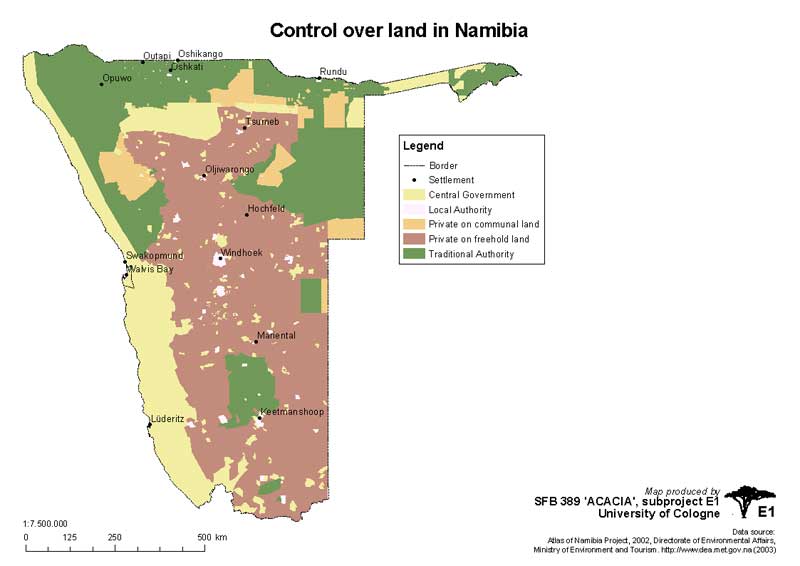
CBNRM has become established as a new layer on top of the existing pattern of land control set up during Namibia’s earlier colonial and apartheid history, as shown in the image above. (The country was a German colony from 1884 until the first World War and then administered by South Africa until 1990.) Most of the central and southern parts of the country were surveyed, fenced and settled by commercial white farmers once Indigenous peoples – other than those who became labourers in commercial farming areas – had been constrained to more marginal areas (the dark shaded areas in the left-hand map [see pdf]). This means that when SCI speaks of bringing “game back onto former natural areas that had been converted into livestock farms”41, in the Namibian context it is (mostly) talking about land already taken by settler farmers from Indigenous African land-users and subsequently enclosed with fencing. In 2018, more than 70 percent of freehold land was owned by “previously advantaged farmers”, which in Namibia’s racialised history means by white settlers.42
It is Namibia’s remaining communally-managed land areas – lands beyond the predominantly white-owned freehold farms – that are the focus of CBNRM. The programme pivots on the registration of communal land areas as ‘conservancies’, with defined boundaries, members, and plans for wildlife management – including the sale of trophy hunts – agreed with the Ministry of Environment, Forestry and Tourism (MEFT).43 As the map on the right indicates [see pdf], communal area conservancies are limited to areas designated under colonialism and apartheid as communal lands where African land-users were permitted to live. The registration of communal area conservancies has not disrupted the highly unequal and enclosed pattern of land distribution established through Namibia’s colonial and apartheid histories.44
Hunting Communal Land
Since Namibia’s independence in 1990, the integration of wildlife conservation with rural development via conservancies in communal land areas has been the focus of an impressive list of donor-funded, NGO-implemented projects. A five-year Living in a Finite Environment project from 1993, extended in 1999, brought major donor funding from WWF and USAID to the CBNRM project. The GEF and World Bank funded an Integrated Community-Based Ecosystem Management (ICEMA) project focusing on selected conservancies from around 2003-2011. The Strengthening the Protected Areas Network from 2004 onwards brought finance from the United Nations Development Programme, GEF and Germany’s state-owned investment and development bank (KfW), and included communal area conservancies in proposals for new forms of protected areas.The German Society for International Cooperation (GIZ) is currently funding ‘biodiversity economy’ initiatives that include communal area conservancies.45
These and other donor-funded initiatives have directed millions of dollars towards developing CBNRM and ‘sustainable use’ initiatives in Namibia, guided by 25 years of leadership by an ecologist and hunting enthusiast from the US who was the former director of WWF-Namibia.46
Just as envisaged in SCI’s 1996 Strategic Plan, conservancies in communal areas are described in part as organisations established to enable business, the premise being that it is through business that both conservation and conservation-related development will arise. The Namibian Association of CBNRM Support Organisations (NACSO) thus writes that a conservancy is “a business venture in communal land use… although its key function is actually to enable business”. Conservancies, therefore,
“do not necessarily need to run any of the business ventures that use the resources themselves. In fact, these are often best controlled and carried out by private sector operators with the necessary know-how and market linkages.”47
One key way in which conservancies can enter into business arrangements with private sector investors is through agreements with commercial hunting operators. Hunting tourism is promoted as a means of generating income for conservancy management structures and members, for example through the payment of fees by professional private hunting operators. The economic value of meat occasionally distributed from trophy hunts is also calculated in as an additional benefit, via an equivalence method using prices of shop-bought meat.48
Hunters are drawn to Namibia’s communal areas in part because they see these unfenced lands, with larger free-roaming so-called ‘game’, as representing a tougher, older Africa. The irony here is that it is precisely Namibia’s colonial and apartheid history of land appropriation that has produced this distinction between (mostly) fenced freehold land and (mostly) unfenced communal land, the latter now fetishised as ‘wild, old Africa’ and thus encouraged to sustain this character for touristic consumption.49
Whose Revenue?
Public data on NACSO’s website lists 27 professional hunting operators (“consumptive wildlife use partners”), accessing Hunting Concessions (“hunting grounds”) in 54 communal area conservancies in 2020 and 2022.50 This means that around 60 percent of the 86 communal area conservancies in Namibia include Hunting Concessions accessed by professional operators. Seven of the listed operators access three or more communal area hunting concessions, with one operator accessing eight concessions. Hunting Concessions in communal area conservancies require land zoned for this purpose, which local people may then be unable to access for food production or other purposes.
Professional hunting enterprises tend to operate from freehold farms in Namibia’s commercial farming areas, and/or include hunts on freehold farms as part of their business, meaning that their access to communal areas is additional to hunting business on these farms. In 2019 over 95 percent of hunting activities in Namibia were reported to be concentrated on freehold farms.51 Communal area conservancies tend to receive higher payments per hunted animal, but this is primarily because it is in communal areas that animals commanding high prices can be hunted. What this pattern translates into is that the vast majority of professional hunters in Namibia are from “previously advantaged groups”, i.e. they are white. In 2013 the Namibia Tourism Board “determined that [only] 1 of 555 trophy hunting operators in Namibia is previously disadvantaged”.52
Professional hunting operators pay a fee to conservancies for a permit to hunt animals approved by the MEFT as part of permitted conservancy hunting quotas, a cost passed on by hunting businesses through their own charges to hunting tourists. The ability of a communal area conservancy organisation to sell a hunting permit to a private operator is intricately linked with observations (“game counts”) recorded in event books by conservancy employees and members, as a central part of conservancy management. Animals that qualify to be hunted are thus in effect ‘made’ through intense daily work by conservancy members, logging observations which allow ‘surplus’ and/or ‘problem’ animals to be identified and potentially allocated as a part of the season’s quota of ‘huntable’ animals.53
An important measure here is the amount of profit made by professional hunters once their fees and other costs have been paid. How does this income compare to the income accruing to a conservancy once its own costs (i.e. payments to staff for event book work, game counts etc.) have been covered?
It is claimed that 100 per cent of hunting revenue goes to local communities54, but it is unclear on what basis this claim is made. Detailed research by Linus Kalvelage and colleagues in north-east Namibia’s Zambezi Region (part of the high-profile Kavango-Zambezi Transfrontier Conservation Area) found that only 20 percent of value generated by the tourism and hunting sectors is captured at conservancy community level, largely in the form of staff salaries or investments in local infrastructure projects, with little of this income being visible at household levels.55
Also in Zambezi Region, close ethnographic research illuminates the creation and flow of monetary values and payments in relation to specific elephant trophy hunts. Lee Hewitson found that the Kwandu conservancy received just over 50 percent of the trophy fee paid by the client to the professional hunting operator, and outlined the limited disbursement of value to those local people whose labour had created the value of the animals identified as potential trophies.56 These and other recent studies echo observations from the 2003 ICEMA project which urged “more equitable benefit distributions of income from renewable natural resources” given that “income generated that reaches households is minimal”.57
In the Namibian context, advocacy against trophy import bans primarily protects trophy hunting businesses on freehold land, and the inequalities on which these are built. This dimension is masked by the rhetorical emphasis on income to communal area conservancies. Whilst payments from professional trophy hunters are important to those conservancies that receive them, this income is marginal in comparison to the wealth consolidated outside communal areas by the national trophy hunting industry.
Enduring Poverty
More than 30 years after independence, and almost 25 years since the first communal area conservancies were registered and Namibia’s CBNRM programme became the recipient of a sequence of multi-million dollar grants, many rural Namibians linked with conservancies in communal land areas remain poor. Earlier this year the World Bank confirmed that 1.6 million people in Namibia (of a total population of 2.6 million) are living in poverty. Namibia also has the dubious honour of having the world’s second-highest measured inequality.58
Kunene Region in the coutry’s north-west is the worst hit. In 2011, 39 percent of its population were classified as ‘poor’, defined as living on less than one US dollar per day.59 In 2021, partly reflecting subsequent years of drought as well as the impacts of COVID-1960, over 64 percent of the region’s population was considered ‘multidimensionally poor’, with the highest poverty intensity level in Namibia.61 Kunene Region is simultaneously notable for having the highest number of conservancies by region by far (38). According to recent NACSO figures it hosts eight professional hunting businesses, operating in 21 conservancy hunting concessions. Alongside these figures, and prior to the COVID pandemic, tourism was the third largest sector in terms of Namibia’s Gross Domestic Product, contributing around 14.7 percent of GDP in in 2019.62
Something seems awry with these figures. What they tell us is that many people in Namibia are significantly and structurally poor, and that this is also the case for areas of conservancy concentration. This entrenched rural poverty exists despite significant national income from tourism, as well as claims for the success of Namibia’s CBNRM programme and the importance of hunting income to this programme.
Lack of opportunity in rural areas, including reduced local production possibilities, has also prompted people to leave conservancies to seek employment, often ending up in highly impoverished circumstances in townships attached to Windhoek, Swakopmund and Walvis Bay. I personally know people who have left Kunene conservancy areas for these reasons, and can vouch for how close to the breadline they are. I know of no analysis of conservancies that documents rural to urban migration from conservancy areas, despite this important individual and household strategy for responding to material poverty and lack of opportunity.
Despite these circumstances, people in rural areas tend to support and delight in the presence of wildlife. Indeed, it is telling that historically Namibia’s communal land areas were often where wildlife remained when it had been been largely removed elsewhere in Namibia, through both colonial-era hunting and the establishment of commercial freehold livestock farms, free from predators and competitors.63 Unfortunately, however, some of the rhetoric now circulating in support of trophy hunting conveys a very dismal view of how people in communal areas view and value indigenous fauna, claiming that
“without the money raised from conservation hunting in Namibia … our rural communities would simply despatch all the cow-killing lions and crop-trampling elephants and rhinos in their local areas and turn the land over to agriculture.”64
It is true that animals that become problematic for people’s livelihoods sometimes need to be removed. But the perspective conveyed in this quote downplays long-established methods for living with indigenous fauna65, as well as ways people care for and value wildlife which go beyond the minimal incomes received from hunters and tourists.
Hunting Plutonomy
Recalling the SCI hunting award categories described above, it is clear that trophy hunting promotes and solidifies a system of land and animal appropriation directed towards the recreational desires of the world’s elite. How else can it be explained that hunters are encouraged to travel six continents and ‘bag’ measured trophies of multiple species? This system consolidates the hyper-inequality that plagues countries such as Namibia, even as hunting advocates repeat the claim that the flourishing of rural households and communal area wildlife alike is dependent on trophy hunting income.
An oft-stated objection to proposed trophy import bans in the UK is that these do nothing to curtail trophy hunting business in the UK itself. I completely concur with this objection, which takes us full circle to one of the roots of trophy-hunting in the modern world, namely the enclosure of hunting parks for elite access in Britain. In his analysis of the original accumulations of land and resources fuelling later capitalist enterprise, Marx noted the destruction of 36 villages in 1079 by William the Conqueror, in order to create a royal hunting ground of the New Forest in southern England.66 Some centuries later, parliamentary Enclosure Acts and the Black Act underscored new capital offences for those “hunting, wounding or stealing red or fallow deer, and the poaching of hares, conies [rabbits] or fish” in regulated forests and in private and royal estates.67
From the UK to Namibia, trophy hunting consolidates elite recreational access to land (as “hunting grounds”) and labour, whilst removing rights of and stewardship by local peoples. Quite apart from animal welfare concerns and other ethical critiques68, hunting business begs forensic analysis for how it shores up inequalities, alienates people from land, diminishes some kinds of productive autonomy, and concentrates ‘wildlife’ in securitised landscape units requiring militarised management. The real challenge is to empower Indigenous users of fauna and flora to enact their knowledge and skills so as to sustain themselves, and the ecologies with which they dwell, into the future.
----------
Sian Sullivan was born in Uganda and grew up partly in Eswatini, where she also lived and worked in a conservation area from 1988-1990. For the past 30 years she has researched cultural and conservation landscapes in especially north-west Namibia, currently through the project “Etosha-Kunene Histories” (www.etosha-kunene-histories.net), a collaboration with the Universities of Cologne and Namibia. Since 2014 she has been Professor of Environment and Culture at Bath Spa University. She is a member of IUCN’s Commission on Environmental, Economic and Social Policy (CEESP) and a Research Associate of Gobabeb Namib Research Institute in Namibia.
Disclaimer: It can be dangerous to make observations that may be perceived as critical of Namibia’s ‘sustainable use’ policies and the form this takes in Community-Based Natural Resources Management. Like others I have experienced misrepresentation, threats and ostracism, even when aiming to support local communities and represent concerns that may become visible in long-term field research engagements more than in short-term visits and surveys. All my work in Namibia has been carried out with the intention of supporting flourishing and diverse human and other lives. I hope this is the spirit in which this piece is read.
References and footnotes
1. Safari Club International African Chapter 1996 Strategic Plan for Africa. Available at www.researchgate.net/publication/263714699_SCI_AFRICAN_CHAPTER_STRATEGIC.... From SCI’s Chapter Locator (https://safariclub.org/chapter-locator/) it appears that there are now no SCI Chapters in Africa, making it less likely that SCI expansionist concerns are locally-driven. SCI’s new (2021) page on International Hunting in Africa promotes pro-trophy hunting sources with little emphasis on alternative views and legitimate concerns: https://safariclub.org/international-hunting-africa/
2. See: www.gov.uk/government/consultations/hunting-trophies-call-for-evidence and www.gov.uk/government/consultations/hunting-trophies-controlling-imports...
3. https://bills.parliament.uk/bills/2971
4. Alex Thomson, ‘Vegas Polar bear hunt auction to fund fight against animal trophy ban in UK’, Channel 4 News, 22 January 2022, https://www.channel4.com/news/vegas-polar-bear-hunt-auction-to-fund-figh...
5. See https://safariclub.org/sci-concludes-its-50th-annual-convention/
6. See eg https://twitter.com/georgemonbiot/status/1350073445975994374
7. Fieldsports News, ‘George Monbiot backs trophy hunting’, Fieldsports News 19 January 2022, https://www.fieldsportschannel.tv/news634/
8. Fieldsports News, ‘Our people’, https://www.fieldsportschannel.tv/ourpeople/, accessed 25 January 2022.
9. https://twitter.com/GeorgeMonbiot/status/1486274032945315840
10. For a recent exchange exhibiting this kind of silencing, see the papers linked at https://stasjakoot.com/2022/05/17/new-paper-conservation-science-and-dis....
11. www.savetherhino.org/rhino-info/rhino-species/black-rhinos/
12. APPG 2022 Trophy Hunting & Britain: The Case for a Ban, https://appgtrophyhunting.files.wordpress.com/2022/07/final-pdf-report-b...
13. Inclusive Conservation Group (ICG) 2019 Non-branded educational Social Media Capability. Grant application to Safari Club International Foundation Hunter Legacy 100 Fund Program, submitted 15 July 2019, viewable at https://wildthingsinitiative.com/inclusive-conservation-groups-grant-req... – originally at https://safariclubfoundation.org/, but now unavailable here.
14. www.causeiq.com/organizations/inclusive-conservation-group,813225246/
15. https://www.causeiq.com/organizations/shikar-safari-club-international-f... ; Kukura, J. 2020 How American hunting organizations conduct information warfare on social media. Wild Things Initiative https://wildthingsinitiative.com/how-american-hunting-organizations-cond...
16. https://wwf.panda.org/discover/our_focus/governance/inclusive_conservati...
17. www.inclusiveconservationinitiative.org/
18. ICG 2019, pp. 1, 4. (emphasis added)
19. All information from ICG 2019.
20. https://wildthingsinitiative.com/
21. Gleicher, N. 2020 Removing coordinated inauthentic behaviour. Meta 8 October https://about.fb.com/news/2020/10/removing-coordinated-inauthentic-behav...
22. https://jammainternational.com/our-news/campaigns-and-communication-mana...
23. Jamma International 2021 Annual Report and Financial Statements for the Year Ended 5 April 2021, linked at https://register-of-charities.charitycommission.gov.uk/charity-search/-/...
24. https://resourceafrica.net/about-resource-africa/#who-we-are; www.conservationvisions.com/about; https://iucnsuli.org/index.php/about/;
25. Jamma International 2021.
26. https://resourceafrica.net/about-resource-africa/#who-we-are; https://communityleadersnetwork.org/
27. https://safariclub.org/official-measuring-forms/
28. https://safariclub.org/world-hunting-awards/
29. www.iucnredlist.org/
30. UN 2019 Nature’s dangerous decline ‘unprecedented’; species extinction rates ‘accelerating’. www.un.org/sustainabledevelopment/blog/2019/05/nature-decline-unpreceden...
31. All detail here is from SCI 2018 World Hunting Award Field Journal, https://safariclub.org/wp-content/uploads/2020/05/world-hunting-award.pd...
32. Greenfield, P. ‘It’s neocolonialism’: campaign to ban UK imports of hunting trophies condemned. The Guardian 1 June 2022, www.theguardian.com/environment/2022/jun/01/its-neocolonialism-campaign-...
33. Louis, M.P. 2022 ‘It’s a form of colonialism to tell us Africans what to do with our wildlife.’ Mail+ 29 June 2022 https://www.mailplus.co.uk/edition/comment/196777/its-a-form-of-colonial...
34. Ibid.
35. See Trade Database run by the Convention on Trade in Endangered Species at https://trade.cites.org/.
36. Louis 2022.
37. Strategic Plan for Africa, pp. 3, 9.
38. Ibid., p. 5.
39. Sutherland, L. 2022 Tanzania, siding with UAE firm, plans to evict Maasai from ancestral lands. Mongabay 18 February 2022, https://news.mongabay.com/2022/02/tanzania-siding-with-uae-firm-plans-to... . See also www.theguardian.com/global-development/2022/jun/24/east-africa-must-reje... and The Land Issue 30, pp. 35-36.
40. Becker, F. 2022 Reframing trophy hunting’s socio-economic benefits in Namibia (commentary). Mongabay 28 April 2022, https://news.mongabay.com/2022/04/reframing-trophy-huntings-socio-econom...
41. Strategic Plan for Africa, p. 3.
42. NSA 2018 Namibia Land Statistics. Windhoek: Namibia Statistics Agency, p. 12, https://d3rp5jatom3eyn.cloudfront.net/cms/assets/documents/Namibia_Land_... see also discussion by Becker 2022
43. MET 1995 Wildlife Management, Utilisation and Tourism Policy. Windhoek: Ministry of Environment and Tourism; GRN 1996 Namibia’s Nature Conservation Amendment Act no. 5. Windhoek: Government of the Republic of Namibia.
44. For a fuller discussion see Sullivan, S. 2018 Dissonant sustainabilities? Politicising and psychologising antagonisms in the conservation-development nexus. Future Pasts Working Paper Series 5 www.futurepasts.net/fpwp5-sullivan-2018
45. All information available in review of literature at www.futurepasts.net/1990-present.
46. Weaver, C. 2016 Trophy hunting creates value for wildlife. HuntNamibia 11 July 2016, https://huntnamibia.com.na/2016/07/11/trophy-hunting-creates-value-wildl...
47. NACSO 2014 The State of Community Conservation in Namibia 2013. Windhoek: NACSO, p. 25 (emphasis in original).
48. Naidoo, R.L., Weaver, C., Diggle, R.W. Matongo, G., Stuart-Hill, G. and Thouless, C. 2016 ‘Complementary benefits of tourism and hunting to communal conservancies in Namibia.’ Conservation Biology 30(3): 628-638.
49. Hewitson, L. and Sullivan, S. 2021 ‘Producing elephant commodities for ‘conservation hunting’ in Namibian communal-area conservancies.’ Journal of Political Ecology 28: 1-24, p. 15, https://journals.librarypublishing.arizona.edu/jpe/article/id/2279/
50. https://www.nacso.org.na/hunting-partners
51. See MacLaren, C., Perche, J., Middleton, A., 2019. The value of hunting for conservation in the context of the biodiversity economy, Vol V in Turpie, J. (ed). The development of strategies to maintain and enhance the protection of ecosystem services in Namibia’s state, communal and freehold lands. Report prepared by Namibia Nature Foundation for the GiZ, on behalf of Namibia’s Department of Environmental Affairs, https://resmob.org/wp-content/uploads/2019/06/2019-06-Hunting_report_Dra.... See also Becker 2022.
52.Abbiati, G.P., Croteau, J.P., Mitchell, L.M. and Samaroo, M.A. 2013 Development of Trophy Hunting Among Previously Disadvantaged Farmers in Namibia. Worcester Polytechnic Institute and Namibia Tourism Board, p. i. https://core.ac.uk/download/pdf/212969052.pdf
53. Bollig, M. 2016 ‘Towards an arid Eden? Boundary-making, governance and benefit-sharing and the political ecology of the new commons of Kunene Region, northern Namibia.’ International Journal of the Commons, 10(2): 771-799, https://www.thecommonsjournal.org/article/10.18352/ijc.702/; Schnegg, M. and Kiaka, R. 2018 ‘Subsidized elephants: community-based resource governance and environmental (in)justice in Namibia.’ Geoforum 93: 105-115, https://www.sciencedirect.com/science/article/pii/S0016718518301490
54. Louis 2022.
55. Kalvelage, L., Revilla Diez, J. and Bollig, M. 2020 ‘How much remains? Local value capture from tourism in Zambezi, Namibia.’ Tourism Geographies, https://www.tandfonline.com/doi/full/10.1080/14616688.2020.1786154
56. See Hewitson and Sullivan 2021.
57. MET 2003 Integrated Community-Based Ecosystem Management (ICEMA) Namibia: Final Report 14 January 2003. Windhoek: Ministry of Environment and Tourism, http://documents1.worldbank.org/curated/en/595771468322488756/text/E8611...
58. Petersen, S. 2022 ‘1.6 million Namibians living in poverty.’ The Namibian 17 January 2022, www.namibian.com.na/6217119/archive-read/16-million-Namibians--living-in... . On inequality, see https://worldpopulationreview.com/country-rankings/gini-coefficient-by-c...
59. GRN 2015, online.
60. Lendelvo, S., Mechtilde, P. and Sullivan, S. 2020 ‘A perfect storm? COVID-19 and community-based conservation in Namibia.’ Namibian Journal of Environment 4(B): 1-15. www.nje.org.na/index.php/nje/article/view/volume4-lendelvo
61. NSA 2021 Namibia: Multi-dimensional Poverty Index (MPI) Report 2021. Windhoek: National Statistics Agency, p. 29, https://ophi.org.uk/wp-content/uploads/Namibia_MPI_report_2021.pdf
62. US International Trade Administration 2021 Namibia Country Commercial Guide www.trade.gov/country-commercial-guides/namibia-travel-and-tourism
63. Sullivan, S., !Uri ‡ khob, S., Kötting, B., Muntifering, J. and Brett, R. 2021 Historicising black rhino in Namibia: colonial-era hunting, conservation custodianship, and plural values. Future Pasts Working Paper Series 13 www.futurepasts.net/fpwp13-sullivan-urikhob-kotting-muntifering-brett-20... ; Sullivan, S. 2016 Three of Namibia’s most famous lion family have been poisoned – why? The Conversation 23 August https://theconversation.com/three-of-namibias-most-famous-lion-family-ha...
64. Louis 2022.
65. Lendelvo, S., Angula, M.N., and Mfune, J.K.E. 2015 ‘Indigenous knowledge used in the management of human–wildlife conflict along the borders of the Etosha National Park, Namibia’, pp. 219- in Chinsembu, K.C., Cheikhyoussef, A. & Mumbengegwi, D. et al. (eds.) Indigenous Knowledge of Namibia. University of Namibia Press.
66. Marx, K. 1974[1867] Capital, Vol I (trans S Moore and E Aveling). London: Lawrence and
Wishart, p. 685.
67. Thompson, E.P. 1975 Whigs and Hunters: The Origin of the Black Act. London: Penguin, p. 22ff.
68. Hannis, M. 2016 Killing nature to save it? Ethics, economics and rhino hunting in Namibia. Future Pasts Working Paper Series 4 www.futurepasts.net/fpwp4-hannis-2016
69. Map (a) source: ACACIA Project E1 2007 www.uni-koeln.de/sfb389/e/e1/download/atlas_namibia/pics/land_history/co...
70. Map (b) source: NACSO, Windhoek, www.nacso.org.na/resources/conservancies-map-a3